

Comboni Missionary Bishop Paride Taban passed away in Nairobi, Kenya, on November 1, 2023. He was 87.


Established in 2004, Kuron Peace Village is a model for those seeking to build new relationships. “I forgive. We forget. Together,” Taban said.
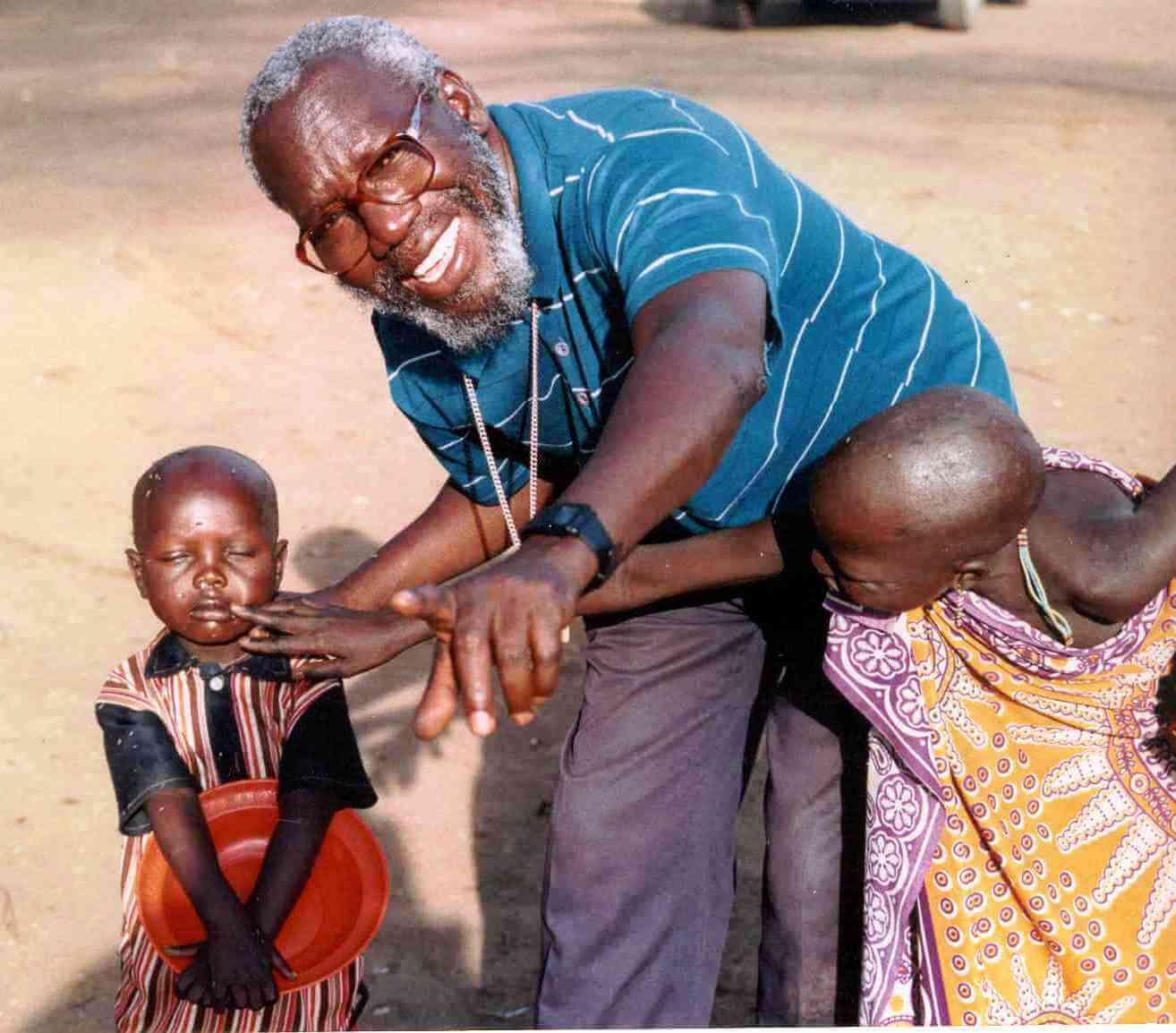
Bishop Taban believed in the power of personal relationships to transform cultures. “You do not fight against your neighbor.”
By: Kathleen M. Carroll
When I first met Comboni Bishop Paride Taban in 2016, he told me, “I have to be a shepherd until the end. Unlike many of my people, I was never a refugee, but I always say that I am a refugee from heaven. So, I will only leave my people when I must return to my home in heaven.”
The trailblazing peacemaker was true to his word. He served his people until his death in November. The passing of the bishop emeritus of South Sudan’s diocese of Torit has left a void in the hearts of many who admired his unwavering commitment to peace in a nation plagued by persistent conflict.
Born in 1936, Taban says that he was first attracted to the priesthood because of how well-dressed the seminarians were. “All these missionaries came to talk to us and they were dressed in long, flowing cassocks — I was very impressed!” He was consecrated bishop by Pope St. John Paul II in 1980. He served as the inaugural bishop of the Roman Catholic Diocese of Torit in what was then Sudan from 1983 until 2004. In 1989, during the takeover of Torit by the rebel Sudan People’s Liberation Army (SPLA), Taban, along with three other Catholic priests, was arrested by the SPLA and spent months imprisoned by rebels in the bush. Until 1990, he and Nathanael Garang were the sole active bishops in areas held by the SPLA.
A Guiding Light for Peace
Bishop Taban’s journey toward becoming a peacemaker began when he was appointed as the first leader of the New Sudan Council of Churches in 1990, a crucial role during the second Sudanese civil war. His efforts in facilitating peace negotiations and defending human rights earned him recognition as an exemplary builder of peace. According to Bishop Marc Stenger, Copresident of Pax Christi International, Bishop Taban’s actions were “infused with the evangelical spirit of Jesus.”
Taban was known for seeking practical solutions to intractable problems, but he was also known for his courage. He credits his pectoral cross for saving his life
when an angry farmer took a shot at him (Taban’s truck had accidentally struck and killed the man’s donkey). “You rarely meet such a beautiful, brave person,” said
Dutch journalist Paul de Schipper.
Building Bridges: Kuron Peace Village
Upon his retirement from the diocese of Torit, Bishop Taban embarked upon one of his most significant contributions to peace in South Sudan: the establishment of the Holy Trinity Peace Village Kuron in 2005. As bishop, he had built a bridge over a river at Kuron. The road had previously been impassable during the rainy season. While the bridge facilitated transportation to an overlooked region of the country, it presented a dilemma.
“That bridge could be a blessing or a curse,” Bishop Taban told Catholic News Service shortly before his death. “Before the bridge, cattle raiding slowed during the rainy season because people couldn’t cross the river. With the bridge, they could raid during the rainy season. So we founded the Peace Village there to reconcile people who were calling themselves enemies instead of calling themselves friends.”
Fitting for a founder who was never afraid to get his hands dirty (Taban was often known to use his mechanical skills to nurture old vehicles back to life), Kuron offers a school, vocational training, agricultural education, health care, and more. It embodied Taban’s vision of a model village, where everyone was welcome. “It is hard to have conflict with those you have known as neighbors,” he said.
A Model of Inclusion
Kuron is intentionally multi-ethnic, designed to bring together peoples from around the region. It helped to ease tensions between cattle herders and agriculturalists and those who literally did not speak the same language. But it also showed girls that they, too, had potential. When onlookers were shocked to see a woman piloting a plane at the village airstrip (yes, the bishop had an airstrip built), Taban explained that she not only had freedom and skill, but that her work would let her buy dozens of cows a month, if she so chose. Girls began to flock to the school.
“We brought people together,” Taban said. “People who had only met as enemies now had to work together to build the village, to provide food, to care for the children.” After this experience, “they do not say, ‘He is from this tribe,’ or,‘that person is not like me.’ They are neighbors, friends.”
“Peace is rooted in communities, not in agreements or rules,” Taban said. His legacy, embodied in the Holy Trinity Peace Village Kuron was one of this idea of community. His work will long continue to inspire a vision of a world where peace and unity prevail.

