
For Christmas, the children each received a new shirt. Sister Rosemary hopes to be able to give them a second shirt this year — along with shorts and a pair of shoes.

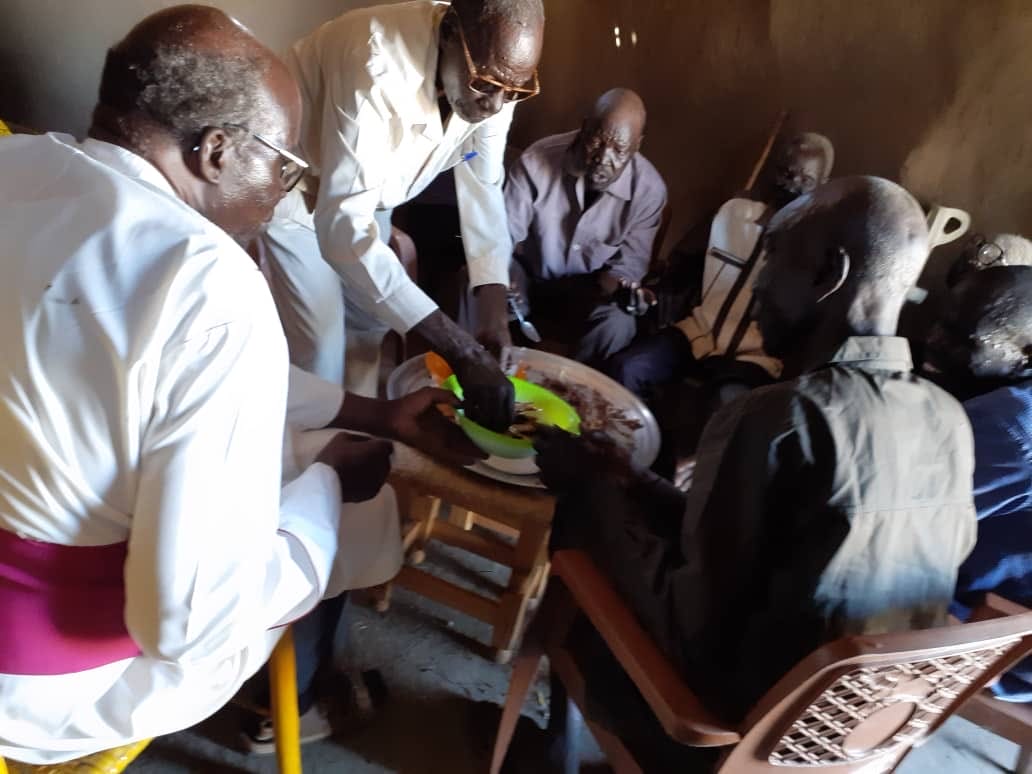
The Church is also providing for the most vulnerable adults as well. Here Bishop Stephen Majwok of the diocese of Malakal helps to feed the blind and elderly in the camp for displaced persons.


Sister Mary works with refugees in the camp at Kosti.
Sister Rosemary Nyirumbe Takes on More Than She — or Anyone — Can Handle
By: Kathleen M. Carroll
It’s almost a scene from a horror film: Hundreds of starving children clinging to life in a cemetery in Juba, in war-torn South Sudan. Passing by, Sister Rosemary Nyirumbe saw tents pitched in a graveyard, providing scant shelter for skeletal children. She shared the story during a visit in April:
“I asked, ‘What are the children doing in the cemetery?’ and was told, ‘That’s where they live.’ I said, ‘This isn’t right. We need to help these children.’”
While it may seem the obvious reaction, it wasn’t immediately popular. The Sisters working in the region are stretching already strained resources to help wherever they can. Taking in so many children in such dire condition seemed impossible.
But Sister Rosemary knew she couldn’t walk away. “I told the Sisters, ‘We must do something. These children can be helped. We may not have the money to sustain a large program, but let’s do what we can.’”
“I said, ‘I will knock on doors in America,’” she recalls, and she did just that. With $10,000 a donor had just given her for upcoming expenses, she launched a feeding program. “I only needed $100 for the travel I had planned,” she said. “The rest can make a start for these children.”
As soon as the program began, it quickly became apparent that the need was far greater than expected. “At first, we had 450 children. And even though I kept the number low, there are many more who need help,” Sister Rosemary says. Initially, the plan was to feed the children once or twice a week—as much as the Sisters could afford— but soon it was clear that more had to be done. “I called a contact in California and explained the dire situation. He told me, ‘If you feed the children three times a week, you’re not helping them, you’re going to kill them.’”
Without hesitation, Sister Rosemary responded, “If we feed them only a few times a week, they will die slowly. If we do nothing, they will die faster. If all I can do is to make them live a bit longer, then that’s what I will do.”
Her urgent plea led to a breakthrough. “The man said, ‘Sister, I’ll give you enough money to feed them every day.’” For several months, the program thrived, but tragedy struck when the donor suddenly passed away.
“The money he gave me ended with his death,” she says. “He was a very generous person and we were able to do a lot of good things with the money he gave us. But now he is gone and so is the money for these children.”
Despite this setback, Sister Rosemary did not give up. Another donation encouraged her and she began to think that she might make some headway with many small contributions instead of one large donation.
“When I came to check on the children, they were still wearing the same clothes they had been in when we found them,” she says. “I asked the Sisters, ‘Why have they not changed their clothes?’ and they told me that they didn’t even have one clean shirt to change into.
We gave them the first Christmas they ever had,” she says, “complete with new T-shirts and a meal.” Sister Rosemary’s work has extended beyond feeding the children. She has provided some healthcare basics.
“We’ve been able to bring medicine from Uganda, though it wasn’t easy,” she says. “I had to be creative to get it across the border, pay extra fees, and ensure it got to the children.” She also emphasizes that these children are not only victims of civil war but also of tribal conflicts. “In Sudan, people focus on the civil war, but there’s also tribal violence. One tribe kidnaps children from others,” she explains.
Many of the children she serves were abducted and either escaped captivity or were abandoned to fend for themselves. Sister Rosemary’s mission is not just about feeding; education is central to her efforts. “I want to emphasize education. This tribe is among the least educated in Sudan,” she says. “If we focus on their education, we can give them a future.”
Despite the ongoing challenges, including securing enough funds, Sister Rosemary remains committed. “Every month, I have been able to give Sister Pasqua $4,000 to care for the children. The money comes from a few dedicated supporters. But when the funds run out, I feel nervous.”
The children are blossoming with the care they’ve been shown. “They’re healthier now, and they’ve asked for school uniforms,” she says, reflecting on their transformation. Her hope is that these children can move beyond survival and thrive. “It is so hard to try to take care of all these children. They need so much and we have so little to offer them. But I want to try. I’d rather fail trying than not try at all,” she says.

