


By: Fr Yousif William, mccj
Some of the oldest Comboni missions in the world have been temporarily abandoned due to armed conflict in Sudan. Father Yousif William is stretched thin ministering to his displaced parishioners and refugee communities. He offers this update to share news of his work.
The plight of the people continues and the fighting still rages. Despite all the present calamities and difficulties, the people have shown remarkable resilience and firmness in their faith, holding onto a kind of hope that no words can fully express. We are doing our best to help them with the Word of God, encouraging them to look to the future with hope that strengthens them and prepares them to face unexpected challenges with courage, no matter how difficult they may be. We are preparing the faithful for a better future in a Synodal Church where everyone sees themselves as an active member, journeying together with others.
As the only priest responsible for four parishes of the displaced, along with a camp on the outskirts of the town, my weekly pastoral schedule is quite full. On Sunday, I celebrate Mass at St. Josephine Bakhita parish in Jeberona. On Monday, I conduct catechesis for those preparing for the sacraments. On Tuesday, I travel to St. Kizito Dar Essalam for Mass. Wednesday is dedicated to the formation of catechists and extraordinary ministers. On Thursday, I go to St. Francis of Assisi Parish in Angola (Banat). Friday takes me to Sacred Heart Parish in Wed Ramly, and on Saturday, I hold catechism classes at St. Josephine Bakhita parish in Jeberona. The faithful of the Nivasha camp on the outskirts request Mass every month, so I have to take one Wednesday away from the catechists for this purpose.
The living situation here is extremely difficult due to unemployment. In such dire conditions, many people are forced to sell everything — even their household utensils and clothes. Some go so far as to dismantle their windows, doors, and roofs to sell in order to afford food. Looters target abandoned houses, dismantling even the bricks. Despite these hardships, the people remain faithful, coming to church to pray, meet others, and share their joys and sorrows.
Movements from one part of the city to another are severely restricted, with checkpoints every kilometer, which delays my journeys to the parishes. We thank the Lord, though, because the situation has improved considerably compared to a few months ago, when there was intense shelling and aerial bombardments. We often had to seek shelter or remain under our beds.
Now, the primary danger comes from drones targeting large gatherings, causing many casualties. As a result, we avoid such targeted areas. During the nights, we still hear the orchestra of sounds of sporadic shootings and shelling in the outskirts. No night passes without the sky lit up from the “fireworks” of antiaircraft Projectiles.
Pastorally, I thought of forming a group of lay helpers to assist me with the work. I am pleased that we now have extraordinary ministers who help me at the altar. For example, at St. Josephine Bakhita parish in Jeberona, three extraordinary ministers assist at every Sunday Mass, which are attended by two thousand of the faithful. They distribute Holy Communion and pray with families of the sick and deceased. They also serve as catechists, helping prepare people for the sacraments. Additionally, we have four groups of the Legion of Mary who lead the rosary before Mass and visit families, particularly the sick or those who have abandoned the Church.
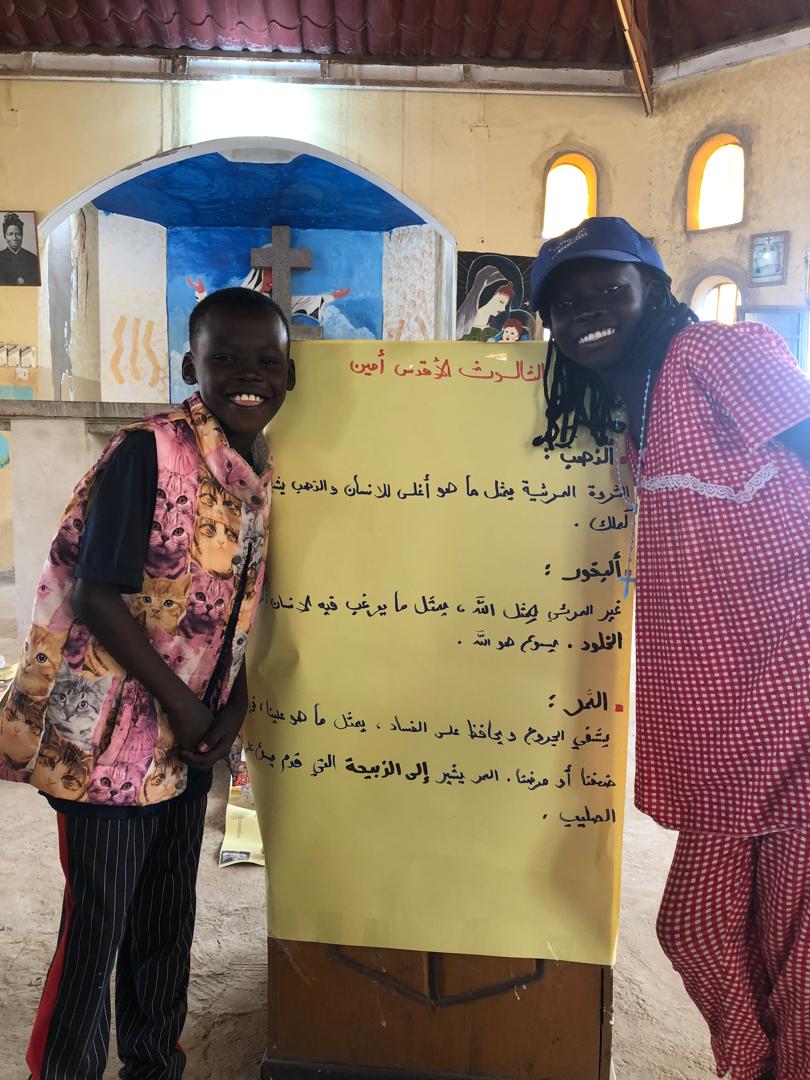
For extraordinary ministers and catechists, we completed a one-year period of basic formation, covering topics such as Catechesis on the Catholic Church, Other Denominations and Sects, the Catechism of the Catholic Church, the Sacraments, Social Teaching, Psychology, the Role of the Laity, the Holy Bible, Christian Family Life, and Pastoral Work.
We also have planned for a future after the war, so two weeks ago we had a course an Organizational Administration offered to us by some volunteers, so that we may have people prepared to get involved with existing humanitarian organizations, to create new local humanitarian organizations, and help in administering projects that will be supported by donors. All of this will be a great help for the Church.
The faithful have taken responsibility for their churches by covering expenses, ensuring water supplies, cleaning, and caring for trees and flowers, as well as supporting my maintenance as their pastor. In all four parishes, they now produce their own wine and hosts for Mass. I have started teaching our choirs the rudiments of music, and they can now sing easy hymns using sheet music.
That is all for the moment. Please keep us in your prayers.

