



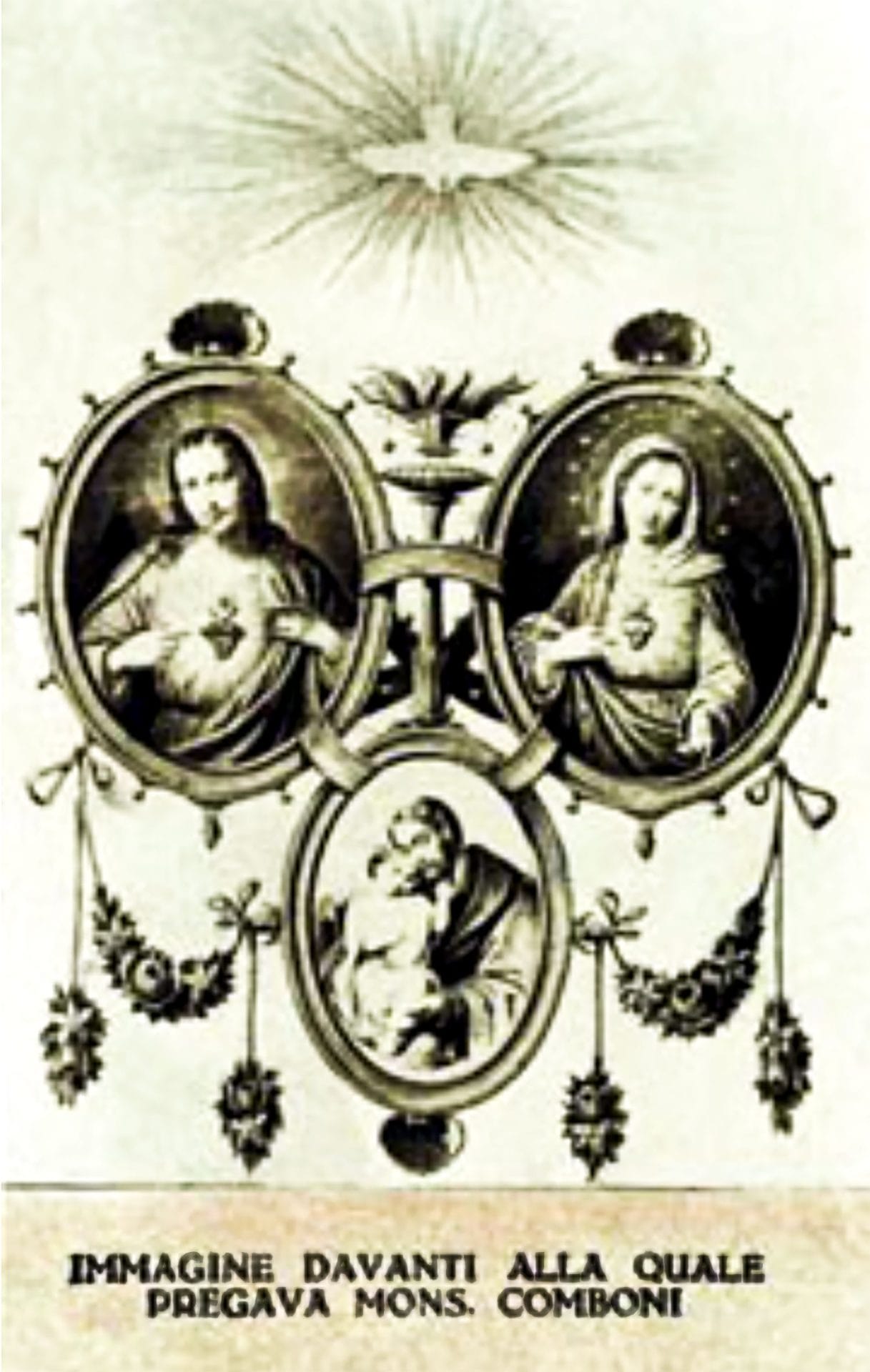
The little image with Jesus, Mary and Saint Joseph, which Daniel Comboni always carried with him and before which he used to pray.


Fr Ismael Piñón
Fr Ismael Piñón, mccj, is director of Esquila Misional, the magazine of the Comboni Missionary’s in Mexico.
By: Fr. Ismael Piñón, mccj
The figure of St. Joseph has had a relevant place in the life and spirituality of St. Daniel Comboni, great missionary and founder of the institutes of the Comboni Missionaries. Through his writings, we can perceive how the husband of Mary and adoptive father of Jesus was always a reference in his life and in his missionary work. He always turned to him to confide not only the material needs of his vicariate, but also his concerns and difficulties.
Comboni’s devotion to St. Joseph most likely began in his childhood, when he saw in his own father, Luigi Comboni, a reflection of Mary’s husband. Comboni was born into a humble peasant family in Limone sul Garda, a small town on the shores of Lake Garda in northern Italy. He was the only surviving child of his parents’ eight children. His father’s financial difficulties and efforts to support the family undoubtedly left a deep mark on the man who would later become the great evangelizer of Central Africa.
There he discovered some images that Don Mazza had placed in the chapel dedicated to St. Charles with the intention of instilling in his students devotion to the Holy Family. Next to an image of the Sacred Heart of Jesus and another of the Immaculate Heart of Mary, there was an image of St. Joseph. These three images must have remained engraved in his memory, because in many of the numerous letters that Comboni wrote throughout his life, he made reference to St. Joseph and the Sacred Hearts of Jesus and Mary.
When Pope Pius IX proclaimed St. Joseph as Patron of the Universal Church on December 8, 1870, Comboni saw his devotion to the saint strengthened and began to venerate him also as “protector of the Catholic Church and of Nigrizia.” This can be clearly seen in a letter addressed to Father Sembianti, the rector of his seminaries in Verona, in which he refers to two small pamphlets on the Sacred Heart and on St. Joseph, which he wishes to recommend to all his missionaries. In this letter, he states: “I would like every missionary and every sister in Central Africa to have these two wonderful books and to become well acquainted with them in order to know well the riches of the Heart of Jesus Christ and the poetry of the greatness of St. Joseph. These two treasures, combined with a fervent devotion to the great Mother of God and immaculate spouse of the great atron of the universal Church and of Nigrizia, are a sure talisman for those who, concerned with the interests of souls in Central Africa, have to deal with people of both sexes in these countries, because they give courage and kindle the charity to treat them familiarly and with ease in order to convert them to Christ and the Virgin.”
On the other hand, Comboni’s devotion to St. Joseph is always linked to that of the Sacred Hearts of Jesus and Mary. His faith and trust in what he calls the “most holy triad” or “the three objects of our love” will be the main spiritual support on which he will rely at all times. This is what he expressed, for example, in another letter to Father Sembianti: “To the child Jesus (who never grows old), to his mother, the Queen of Nigrizia, and to my dear treasurer St. Joseph (who never dies, nor goes bankrupt, but knows how to manage well and with great judgment, and is a perfect doer), to these three dear objects of our love I am going to make a novena, to obtain the grace that before the feast of the marriage of the Blessed Virgin, or on that holy day, dear Father Sembianti will be installed in his important position as rector of the African Institutes of Verana. St. Joseph, who is the paradigm of a good man, has never denied me any temporal grace; but united with Jesus and Mary, he forms a most holy triad that will undoubtedly grant this spiritual grace that I ask for.”
St. Joseph and Providence
In this letter, we can also perceive another characteristic of Comboni’s devotion to St. Joseph, whom he considered as “his treasurer” and to whom he did not hesitate to turn in particular to deal with the immense financial needs of his work. Because of his humble origins and the training he received at the Mazza Institute, Comboni always knew that he was in the hands of divine Providence. Even in the most difficult moments, he did not fail to place himself in the hands of the one he defined as “a source of charity for the unfortunate and always the protector of innocence and justice.”
In a letter to Cardinal John Simeoni, then Prefect of the Congregation for the Propagation of the Faith, he expressed himself in these terms: “But as one must always trust only in God and in his grace, for whoever trusts in himself trusts (with all due respect) in the biggest donkey in this world, and considering that the works of God always begin at the foot of Calvary and must be marked with the adorable seal of the cross, I have thought of abandoning myself into the arms of divine Providence, which is a source of charity for the unfortunate and always the protector of innocence and justice.”
This conviction that Providence never abandons him, together with his devotion to St. Joseph, meant that from the beginning of his mission he declared St. Joseph to be the treasurer of his work, never doubting him. He expressed this clearly to Cardinal Alessandro Franchi in 1876: “How can one ever doubt divine Providence, nor the solicitous treasurer St. Joseph, who in only eight and a half years, and in such calamitous and difficult times, has sent me more than a million francs to establish and launch the work of the redemption of Nigrizia in Verona, Egypt and inland Africa? The financial and material means to support the mission are the least of my concerns. All I have to do is pray.”
And in another letter to Monsignor Jerome Verzieri, Bishop of Bretia, he says: “I assure you, Monsignor, that the bank of St. Joseph is more solid than all the Rothschild banks. Thus, without finding me with a single cent of debt, this excellent bursar maintains for Nigrizia two houses in Verona, two in Cairo, two in Khartoum and two in El-Obeid, the capital of Kordofan, which has more than one hundred thousand inhabitants, and where Mass was celebrated for the first time and Jesus Christ was adored in 1872.”
From these and many other letters, we can also see the familiarity with which Comboni addresses St. Joseph, a familiarity that does not take away one iota of the devotion and respect he feels for his holy protector, but which is also a sign of the great trust he has in him. This is how he spoke of him in another of his letters: “I have also called my treasurer, St. Joseph, to order, and threatening to go to his wife if he does not listen to me, I have demanded that within a year, starting from last May 12, he balance my budget; but not in the style of Lanza, Sella and Minghetti, or of the current Italian Minister of the Economy, Semits Doda; but the true budgetary balance; otherwise I will go to his wife.”
It was in times of scarcity and difficulty that Comboni showed his greatest trust in St. Joseph. During the famine in Sudan in 1878, Daniel Comboni wrote to Cardinal Giovanni Simeoni telling him how expensive everything was, especially bread and water, and how he trusted that St. Joseph would help him to get through it: “There are thousands and millions under the care of St. Joseph; and I have him so harassed and have subjected him to such a besieging of prayers that I am absolutely certain that the present critical situation in Central Africa will soon be transformed into prosperity. Time and misfortunes pass, we grow old; but St. Joseph is always young, always has a good heart and upright intentions, and always loves his Jesus and the interests of his glory. And the conversion of Central Africa represents a great and permanent interest for the glory of Jesus.”
Here we see another aspect of Comboni’s devotion to St. Joseph. According to him, Joseph “always loves his Jesus and the interests of his glory.” Joseph is that father who feels that his son is a part of him, the interests and desires of his son become his own interests and desires; and if Jesus wants the conversion of Central Africa, St. Joseph will do everything possible to ensure that this desire is fulfilled. It is not a physical paternity, but rather a spiritual and heartfelt one. Joseph’s love for his son Jesus becomes a paternal love of Joseph towards all humanity, for which Jesus gave his life in a supreme act of love. This is how Comboni sees it and lives it.
Faithful to the End
But where does Comboni’s strong devotion to St. Joseph come from? Is it just a pious spiritual devotion that was born with that image in the chapel of Don Mazza’s institute, or is there another reason? If we look at Comboni’s personality, his character, his frenetic activity in the few years of his life, his travels, his letters, or his obsession with the conversion of Africa, we would rightly say that he has little in common with Mary’s husband, a simple, humble man, of whom we barely hear in the Gospels. There must be something else in St. Joseph that caught Comboni’s attention: that something is, possibly, his humility and his fidelity to God.
Joseph was not a great figure in the village of Nazareth, he did not have any important rank in the Jewish society of that time; he was not a prophet or a priest, he did not stand out in anything; he was a simple carpenter who accepted with faith the project that God proposed to him, and he did so in a humble and simple way, in silence and discretion, but with absolute fidelity and enormous trust in God. How else could he have welcomed Mary into his home when she was already pregnant by the work of the Holy Spirit? Seen in this way, we can affirm that the figures of St. Joseph and Comboni are similar; in their fidelity to God’s plan for their lives, a fidelity that goes beyond any fears, possible criticism, or difficulty. A trust that goes to the end. Comboni accepted the mission that God had entrusted to him and never doubted it, not even in the worst moments of difficulty or misunderstanding. He always went forward. What’s more, it was in those moments of difficulty that he entrusted himself in a particular way to St. Joseph.
St. Joseph, Model of the Missionary Vocation
We cannot fail to mention St. Joseph as a model for the vocation of the missionary brother. Comboni wanted to have among his missionaries consecrated men who, without being priests, would carry out such important tasks as construction, agriculture, medicine, etc. In fact, in his writings and in the rules of his Institute, this figure of the missionary is contemplated. In a letter to Father Amoldo Janssen, founder of the Missionaries of the Divine Word, Comboni even goes so far as to admit that the brothers have more relevance in the apostolate than the priests themselves: “In Central Africa the well-prepared artisan brothers contribute to our apostolate to a greater extent than the priests to conversion, because the black pupils and neophytes (most of whom, whether to learn the trade or to work, have to remain for a fairly long time with the “masters” and “experts,” who, with word and example, are true apostles to their pupils) are with the lay brothers, and observe and listen to them more than they can observe and listen to the priests.”
The work of the brothers in the mission, focused on material and professional work, is fundamental for the success of evangelization. Their presence is more discreet than that of the priest, but no less effective. Perhaps for this reason and because the saint was a carpenter, a man of practical work, St. Joseph has always been a model for the brothers, who see in him an example of humility, service, and fidelity.
Today, seminaries, schools, hospitals, training centers, parishes, and countless other health care centers of the Catholic Church throughout the world bear the name of St. Joseph, patron of the universal Church and father and protector of all humanity. Pope Francis’s decision to dedicate this year to him is a magnificent opportunity for Christians — and missionaries in particular — to discover the depth and importance of this man who, in a humble and faithful way, changed the course of our history.

