
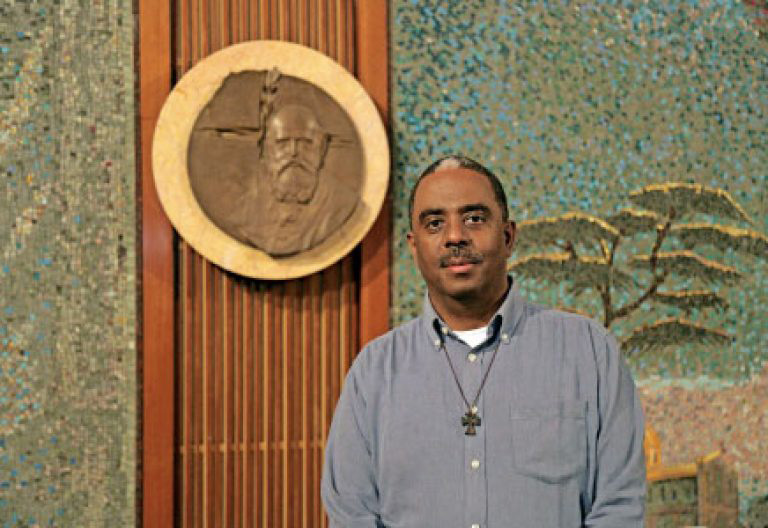
Superior General Tesfaye Tadesse during a visit to the North American Province.
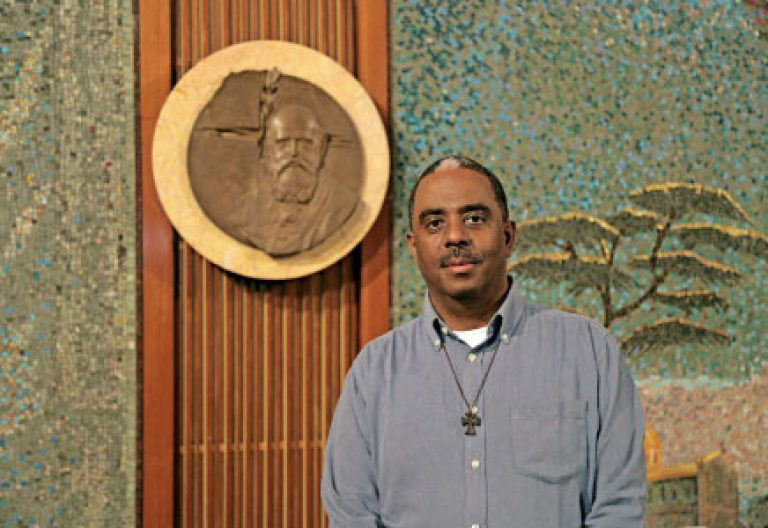
Fr. Tefaye Tadesse in Bernini’s colonnade in the Vatican, last June.



Bro Lwanga Kakule Silusawa
is a Comboni Missionary brother working in our magazine Afriquespoir in Kinshasa, DR Congo.
The Ethiopian Fr. Tesfaye Tadesse has been reelected superior general of the Comboni Missionaries. In conversation with MUNDO NEGRO and Afriquespoir he talks about his first mandate, the lines marked in the Chapter, migrations and the lack of vocations.
You have just been re-elected superior general of the Comboni Missionaries. How do you feel?
I did not expect to have to stay in Rome, but at the XIX General Chapter the capitular brothers asked me to continue my service. I accept your request with faith, confidence and simplicity to serve our institute and the Mission. I trust that the capitulars and the entire Institute will resume our human, Christian and Comboni path, increasingly convinced that we are the branches and that Jesus is the vine.
You have animated the Comboni Missionaries between 2015 and 2022. What has changed in the Institute during this time?
The Institute has made a path that does not depend on one person or a group of people, but on all Comboni missionaries with the help of God. We have walked through our commitment to announcing the Gospel, to witnessing Christ, and to serving our brothers according to the ministries to which we have been called. We wanted to be responsible with the new vocations, especially those that come, in large numbers, from some [Comboni] provinces in Africa. We have continued our reflection on the common call to fraternity in our intercultural communities, and we have grown with the Church and the world in sensitivity to the care of creation and to live well our relationship with nature through the acceptance of the indications of Pope Francis in Laudato si’.
We grow in dialogue with the world because we believe that we are all brothers and sisters. We have reflected together on how to manage the common goods we have for the Mission and how to be supportive both inside and outside the Institute. As we saw during the Chapter, we have also tried to reflect and manage our frailties and limitations with a spirit of responsibility and in an attitude of continuous conversion. However, I would leave it to others to evaluate and judge the work done by the General Council.
What does this reflection suggest to you?
I believe that what emerged from the Chapter, the seeds of life that we have, the illnesses that we suffered and the dreams that we want for our Institute, clearly tell us that we are trying to walk and serve the kingdom of God. Through reflection on the founder and the rule of life we have grown in our identity. We are happy that the Pope has approved the possibility that non-cleric brothers can serve as superiors, which can also be applied in the Institute. Furthermore, in our communities we have walked these years as a Comboni Family alongside the Comboni Missionaries, the Comboni Secular Missionaries and the Comboni Lay Missionaries.
What objectives are set?
Among the many objectives we have, we have highlighted five: the need to have a strong spirituality and a clear identity lived in joy, to seriously commit ourselves to the formation of our young people, to be generous in the service of requalifying our commitments according to the spirit of ministerialism and use well the resources we have to serve the Mission. These challenges concern each missionary and the entire Institute. Another challenge is community life developed in intercultural communities. We will make a good itinerary if we walk together, happy to belong to
a community that supports us and to which we make our contribution so that it is a cenacle of apostles where we are all disciples and missionaries.
What challenges does the teaching of Pope Francis pose to the Comboni Missionaries?
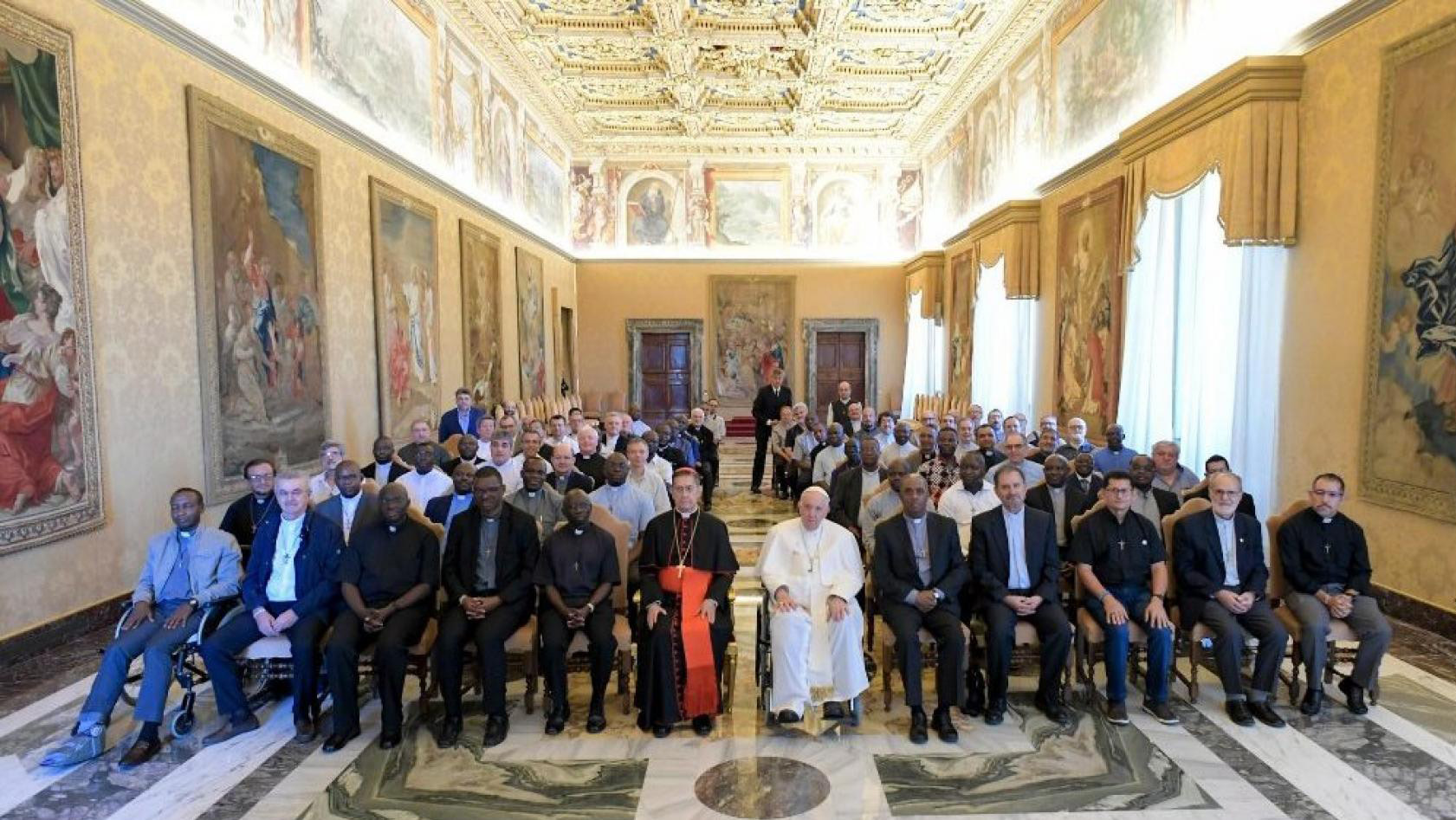
Pope Francis’ challenges are for the entire Church. As far as we are concerned, I would stay with this phrase among the many beautiful ones that the Pope addressed to us during the audience he had with the capitulars on June 18: «If we are like branches well united to the vine, the sap of the Spirit passes from Christ to us and everything we do bears fruit, because it is not our work, but it is the love of Christ that acts through us.
Currently, the congregation is present in contexts of conflict or instability in Africa: DRC, South Sudan, South Africa, CAR… What is its role in these scenarios?
We Comboni Missionaries, as we have been doing since the time of our founder, Saint Daniel Comboni, and as the Comboni Missionaries, the Comboni Secular Missionaries and the Comboni Lay Missionaries have also done, walk with people who suffer, making common cause with them and sharing our faith that God is with us, even in the midst of the suffering of the people of the world. We carry the message of the Good News that gives hope and strength to walk and build the kingdom of God.
What reading do you make of the arrival and the treatment that migrants receive when they reach the borders of the European Union?
The Comboni Missionaries, following the example of Comboni himself, who built boarding schools for Africans in Cairo and who brought Africans freed from slavery to Europe, have a long tradition of service to immigrants, a service with which we continue in the current context of Europe. We are glad that our missionaries are committed to welcoming and helping brothers who are forced to emigrate for various reasons.
Pastoral care for these brothers is agreat challenge for local Churches and for our congregation. The reality of migrations is very complex and European governments respond from a political point of view, while the Church and Comboni Missionaries try to do so according to the evangelical criterion, taking into account human dignity and the care of people. We thank Pope Francis for his example of life and his teaching about caring for the marginalized and immigrants.
How does the Institute face the vocations crisis in Europe? What do you do to maintain a significant missionary presence in the Old Continent?
Like the entire Church, Comboni Missionaries are also realistic and realize that vocations are decreasing on the European continent. However, we are also convinced that the Lord continues to call people on this continent to bring the Good News: they may be vocations of adults, of people called to the contemplative life, of disciples called through different ecclesial movements, and also vocations of lay missionaries. In recent years we have accelerated the internationalization of our provinces in Europe, where not only Europeans work. This is the reality of the Church.
Europe offers many ofits riches as an ecclesial reality and also its challenges, and continues to be part of the Mission of God. We must continually discern how to continue our presence here, accentuating our commitment to evangelization and our ministerial service in the reality of the Churches in Europe. As on other continents, the Church is dynamic and constantly changing, so the challenge is to discern the signs of the times in each place and context.
He told us that the majority of Comboni vocations come from Africa. Furthermore, there are two Africans in the new General Council. Has Africa’s time come? Has the dream of Saint Daniel Comboni come true?
You ask me if it is the time of the Africans? I am one of those who believe that we are all necessary and I prefer to talk about God’s hour in which we all participate. Saint Daniel Comboni, his missionary commitment in Africa and all Comboni missionaries belong to God. Our participation in God’s Mission goes according to God’s plan and time. It is always God’s time, not that of a particular group or another, although sometimes the Comboni Missionaries of a certain continent during a specific stage have contributed in a special way.
But on the issue of vocations in the Institute, the importance of the African continent is undeniable.
It is true that in recent years our Institute has been receiving the gift of new Comboni missionaries from the African continent. We Africans, who have received
much from missionaries from other continents, especially from Europe and America, respond to the missionary and Comboni call with a spirit of gratitude. The large number of our candidates and young African missionaries in training demands a lot of personnel and resources and the entire Institute is contributing to this with a great sense of responsibility. Experience has shown us, on all continents, that vocations are a gift from God and also an individual and community response to a demanding call. We give thanks for the gift of vocations and ask all of us to commit ourselves to living our consecrated and missionary life with joy, giving a good witness with the help of God and the community.
The fact that in recent years the majority of our vocations come from Africa shows that the Christian communities of the continent are increasingly generous and solid, and for this we thank God. As Pope Francis says, all Christians are called to be missionaries, indeed, “to be Mission.” There are institutes that were born and raised in Asia, and therefore have many Asian vocations, and today many of the services are directed by Asians, although not exclusively. There are congregations that were born and raised on the American continent and now many of their members come from America. And the same thing happens for some congregations born in Europe. We, thanks to Saint Daniel Comboni, were born for and with Africa and have grown up on the African continent; We were sent to other continents and we were enriched by those experiences and now we have many vocations in Africa. The fact that the Comboni Missionaries of Africa, like those of other continents, are called to serve at different levels and places is part of the history of our Institute which, as the founder himself said, “is neither Spanish nor French nor Italian.” not German, but Catholic, that is, universal.

